Showing posts with label parables. Show all posts

Thursday, November 13, 2014

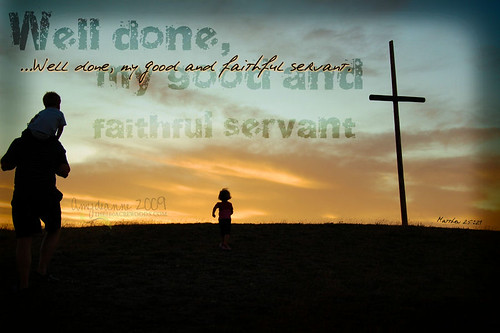
"Well done, my good and faithful servant."


Jesus has some words this Sunday about investing what we receive. He tells the famous parable of the talents. The man who receives five talents, put them to work and made an additional five. The second receives two and makes two more. But the man who receives one talent, buries it. Jesus calls him "wicked" and "lazy." Our Discussion Questions will guide your Sunday Bible Study with family, friends and church groups.

A Different Kind of Accountability


This Sunday's Gospel story presents us with the last of the three parables that form Jesus' final discourse in Matthew's Gospel. Each of the three parables relates a different kind of accountability required of Christians as they prepare for their glorious encounter with Christ.

The central message of today's Gospel parable concerns the spirit of responsibility with which to receive God's Kingdom: a responsibility to God and to humanity. When the Master gives the servants the talents to look after he basically turns them from servants into managers. Fr. Alex McAllister SDS says they are now expected to make decisions about how to manage the vast amount of money placed in their care. But despite this promotion, Father Cusick points out that we all remain servants of God. And we are still responsible to God for the way we use the abilities He has given us.

We are also to realize that like the three servants in Sunday’s Gospel, what each of us has been given is different. Some of us have received short straws. So, Fr. John J. Ludvik explains, Jesus does not expect us to “measure up” to our neighbor, per se. But we are nevertheless expected to give life a first class run with these gifts. We are not to bury our talents. How we use our abilities to enrich and help others is our fulfillment of Christ's command to love others as we love ourselves. And Love, explains Fr. John Foley, S. J., is the only one thing he knows spiritually that goes away if it is buried, but which gets greater if used.

Fear Factor


We live with fears. Fr. Orlando, Sapuay, M.S. says some of these fears are so complex or long-standing that we don't even know how we got them or where they originate. But in this passage, the one-talent man not only confesses he was afraid, but he gives us a hint of why that is true. The Good News of Jesus Christ, Fr. Thomas Rosica, CSB explains, is that we must abandon fear and be industrious, reliable and creative in doing God's will, lest we turn out to be like the third slave, "worthless, lazy louts"!

Our failure to take heed of the rest of what Jesus has said has sometimes made for a spirituality that is a half-truth. Fr. Ron Rolheiser warns us that in the name of religion, we have sometimes become unhealthily fearful, timid, and guilt-ridden. This means that the mere avoidance of serious sin does not make for good Christians. And if we are not moving forward, as Fr. James Gilhooley wisely cautions us, chances are good we march full speed backwards. So, perhaps we should extend the meaning of the parable a little further and think of the many ways that the life entrusted to us can be wasted, even without doing evil things. Fr. Campion P. Gavaler explains this in his reflection.

Be Ready for the End

Should we be afraid of death? Should we be afraid of the end of time? Fr. Joseph Pellegrino quotes St. Paul who tells the Thessalonians - we know that we should but we shouldn’t be afraid that it will catch us off guard. And what is the antidote to fear? It is this: an attitude of gratitude. Whatever God has given you, Fr. Phil Bloom urges us all, thank Him and ask his help to invest it as best you can.

Feast of the Dedication of St. John Lateran Church


Last Sunday, we celebrated the Feast of the Dedication of the Major Basilica St. John Lateran. It is one of those few feast days on the Church’s calendar that require some digging before its value is even minimally appreciated. When we do invest the time, the yield is rich. So Sr. Margaret J. Obrovac, FSP took out her shovels and uncovered some gems. Paul Dion, STL also takes this opportunity to communicate an important element of our Catholic Faith tradition that we do not often consider. It has to do with the churches that have played an important role in our history as Christians.

Purposeful Prayer, the Bible & Catholic Wellness


It may surprise you to learn that America is decidedly pro-Bible. According to research commissioned by American Bible Society, Barna Research polled 2,000 Americans and discovered that nine out of 10 households own a Bible. A full 86 percent of people surveyed indicated that they consider the Bible to be sacred or holy. That’s the good news. The bad news is why aren't they reading it?

This reflection by Msgr. Charles Pope may help us understand the role the Bible plays in our lives. He says only with God’s help can we begin to realize that “The Most important things in life aren’t things” is more than a slogan. Only with God’s help and a lifetime of grace can we ever hope to really appreciate this insight and absolutely true. In heh second of his two-fer reflection on the Bible, he looks at the story of St. Paul’s arrest, beating and imprisonment at Philippi that serves as a kind of paradigm for the radicality of true Christianity and why it so perturbs many in this world.

Cheryl Dickow also delivers her own two-fer this week. In the first one, she talks about Catholic Health and Wellness. She expresses how she has come to realize that while the initial good intention is a necessary first step to health and wellness, a viable course of action must accompany it—preferably something not too painful, boring, or time-consuming. And in her second reflection, she warns about how we often try to insert our own liberties and try to direct God in our prayers every time we suffix the words "so that..." to them. Think about that for a second.

From the Vatican, two stories likewise come down from the pope. ‏First, Benedict XVI is recommending that young people use the Gospel as they make future plans. And secondly, he reminds the world that death and life in Christ is more than a changing season. He says God's intervention in the drama of human history does not obey any natural cycle. It only obeys His grace and faithfulness.

Top Ten Lists

Here's a couple of Top Ten lists we encountered this week. The first is "10 Steps To Get Involved in the Pro-Life Movement" by Susan B. Anthony. You might have said to yourself: I am opposed to abortion, I want Roe v. Wade to be overturned, I want pro-life heroes to be leading our country and the states, but HOW? This article's for you.

The second list presented by Donna Hicks is a bit more philosphical. It talks about powerful internal self-preservation forces we have that can be so harmful if we don’t develop an awareness of them, and learn how to restrain them. She calls her list the “Ten Temptations”-- ways to maintain your dignity when your instincts think they know better.

Church-Goers and Not


A Gallup report that fewer Democrats than Republicans tend to be churchgoers. About 52 percent of Democrats or those who lean Democrat seldom or never attend church. Among Republicans or those who lean Republican, 38 percent say they seldom or never attend church. Do what you wish with these numbers, but one soul turned away from God - regardless of political party affiliation - is one too much. So we Catholics have our work cut out for us.

Which brings us to the church-goers, some of them you've talked to when they knocked on your doors many times in the past. I am talking about the Protestant missionaries the likes of which I have had the frequent pleasure of entertaining on my front porch for Bible sharing. And I must admit equally for frequent Bible misunderstandings. I can't help but share this funny story from Patrick Madrid. It is a hysterical albeit mythical account of an encounter between a pair of Mormon door-knockers and a Jehovah's Witness homeowner. I mean no disrespect by sharing this tale. But there are some Catechetical lessons Catholics can learn from this.

We Need Your Help Today

For the first time ever, we are sending out an appeal for assistance from our readers. It is no secret that this economy has been hard on Catholic parishes. And it has not been easy for us as well. The Gospel for this Sunday tells us that what Christ has given us is multiplied in its giving.So we ask you to please consider giving a financial gift to our ministry. We will use your gifts - all 100% of it - to construct parish websites and mobile apps for the many needy parishes that currently wait for us to gift them with our service ministry.

Proverbs 19:17 tells us: "He who is gracious to a poor man lends to the LORD, and He will repay him for his good deed.” Your assistance to us will indeed be a good deed in the eyes of God. For you are not just helping our ministry. You are also helping many communities of faith stay strong to their Catholic roots, beginning with the grateful parish members of St. Aloysius Catholic Church in Buckley, WA. Please click here to send your contribution.
Another eventful week in our Catholic World. A blessed and happy new week to all.

Keep the Faith. Peace.

Wally Arida
Publisher & Editor in chief

BURNING QUESTION: Is it OK for God to get angry?
FEATURED BLOG: "So that..."

Post a comment.
Follow us on Twitter
Click Here to receive a FREE SUBSCRIPTION to this weekly email
--

Thursday, October 9, 2014

"Many are invited, but few are chosen."


This Sunday the Church presents for our consideration the wonderful parable of the royal wedding banquet. Our Discussion Questions will guide your Sunday Bible Study with family, friends and church groups.

Invite Everyone to the Banquet

The message of this parable of the royal wedding banquet is clear. God invites the people of Israel to his wedding banquet in heaven but despite the fact that they have enjoyed his favour over so many generations they do not come.

Jesus shed His blood for all. Fr. Phil Bloom affrims to us that our Lord invites all to the heavenly banquet. And this, Fr. Alex McAllister SDS says, is certainly good news for us. We are Gentiles and we have taken up God’s invitation and we are here at the great banquet he has prepared for us. In Christ, the abundance of the kingdom of grace and peace, the banquet of God's goodness, is poured forth for all: "...you must go out into the byroads and invite to the wedding anyone you come upon." For God, Father Cusick explains, there is no "A" list or "B" list. All are called to accept adoption as His sons and daughters, and to share the bounty of the wedding hall.

But one of the most dangerous temptations for traditional Christians, cautions Fr. Demetrius R. Dumm, O.S.B., is an easy assumption that they have responded to God's invitation and are now comfortably seated at the banquet waiting for their final and inevitable heavenly reward. This temptation is so insidious because it really is based on the fact of faithful religious observance.

Proper Attire for the Feast

Matthew's addition of the guest without the wedding garment can certainly leave the reader perplexed. As early as the second century, Irenaeus wrote that the wedding garment signified works of righteousness. Fr. Thomas Rosica, CSB tells us today that it signifies repentance and a change of heart and mind. This is the condition for entrance into the kingdom and must be continued in a life of good deeds. To illustrate this point, Fr. Joseph Pellegrino speaks about how Jesus took a man named Saul, a man who murdered Jesus’ first followers, and transformed Saul into Paul, the great apostle of the early Church.

The Lord does this for each of us. He takes each of us, with all our humanity, with all our weakness, and He uses us to make Him present to others. He does this, explains Fr. Orly Sapuay, M.S., because our faith is a love story, not a strategy. It is loving the greatest lover of all. He says now is the time to begin weaving our garments, to begin loving God with our whole soul, and heart, and strength, and to begin loving our neighbors as ourselves. Now is the time to seek that selfless love—to put on that spotless wedding garment—that will save us.

The Banquet of the Eucharist

Sunday’s readings also foretell a messianic banquet. Isaiah, chapter 25, describes the meal as both earthly (“on this mountain”) and heavenly (“he will destroy death forever”). Fr. Demetrius R. Dumm, O.S.B. explains that Jesus did not just mean a kingdom located in heaven. He also meant a community of believers on earth who accept the rule of God and who hope to find a place eventually in heaven. And this kingdom, though only fully realized in the future, does have a present embodiment – the Mass.

Fr. John J. Ludvik reflects upon how Sunday Liturgy should permeate our lives. We can’t survive without the Eucharist. Every parish is a microcosm of the universal Church, deriving strength to carry on our mission and ministries from the Eucharist. But, Fr. Ron Rolheiser adds, Christians argue a lot about the Eucharist. What does it mean? What should it be called? How often should it be celebrated? Who should be allowed to fully participate?

Quite often the charge against the Church is it removes joie de vivre from life. But Fr. James Gilhooley is quick to point out that the early Christians got the point. They possessed a "certain holy hilarity." They went about their lives with a bounce in their steps and a smile on their faces. And they attracted millions of converts. And so Fr. John Foley, S. J. reminds us also that Jesus did both: He fasted and He feasted. This Sunday readings invite us to come in, to open up, eat, enjoy what is there. To receive as Jesus did. But when it was time to let go of it all—life, friends, peace and possessions—our Lord did that with love. Jesus wants us to receive his life and then give it out to the world.

October - Month of the Rosary


It’s not an overstatement to say that the family Rosary can and must play a pivotal role in the renewal of our society. For that reason, especially during this October month devoted to the Rosary, Leon Suprenant encourages families to make the Rosary part of their daily life.

Here's a question from a reader? Is it appropriate to recite the Marian prayers before the Blessed Sacrament? Fr. Edward McNamara responds that genuinely praying the rosary in any circumstance should always bring us closer to Christ and will never give more importance to Mary than to Him. If that were to happen, then it would mean that we have still to learn how to pray it as the Church, and indeed the Blessed Mother herself, desire it to be prayed.

Prayer, St. Jerome & Lectio Divina


Fr. Mark Daniel Kirby brings us the story of St. Jerome, the translator of the original Hebrew and Greek texts of the Bible into Latin, the tongue of the common folk. He was a lover of the poor Christ who sang the praises of monastic solitude, saying that “monks do on earth what the angels do in heaven.”

‘I’d like you to convert Chicago,” was how Francis Cardinal George, archbishop of Chicago tasked Fr. Robert Barron about nine years ago. The result may just be on a PBS station near you this fall. Father Barron has created a remarkable book and TV series called Catholicism. It is openly a work of evangelization and is done in a way that is welcoming to a wide potential audience.

And so how can we bring others, especially those we love, into a right relationship with Jesus Christ? And how can we ourselves come to know and serve Jesus better? Joe Heschmeyer talks about how almost every Christian struggles from time to time with at least one of these two questions. And how if we don't, we should. Then Dr. Lilles offers a nice followup regarding the gift of intercessionary prayer. He tells us that the more we love someone we also see how much they suffer, and the more we see this, the more their plight moves us to humbly seek God on their behalf.

Steve Jobs & John Wayne

Steve Jobs, the man who more than anyone shaped the technological landscape we live in passed away on three years ago. The word genius will be thrown around a lot about him, but that word genius misses the point. Many people have genius, but few geniuses have the kind of flexibility, endurance and ability to admit wrong turns, face them and correct them. The Secret to Jobs' Success? "Live Every Day As If It Were Your Last"

John Wayne, for many, was a Hollywood legend who symbolized true masculinity and American values. To Fr. Matthew Muñoz, he was simply “granddaddy.” This priest of Orange diocese reflects on the conversion of his grandfather to Catholicism.

Parents, Teenagers & Dating

For fifteen years Judith Costello has been a freelance writer. Before that she was a full-time artist. These are not the kind of professions with a guaranteed income! And lately, as the jobs and paychecks dwindle into meagerness, she finds herself staring at the neighbor lady as she drives off to work every day. And suddenly, she finds herself feeling jealous! Wow. Now that was a shock to her!

Here are a couple of sets of Catholic advices - one to teen-aged dating. And another for the parents of these very teen-agers.

Julie Rodrigues starts off with "10 Tips for Catholic Dating." She says if you are still single, know that a boyfriend/girlfriend is a gift, not something you can force or work for. Live your life focused on putting God first, investing in a deeper relationship with him and with others, but remaining OPEN. Open to whoever He puts in your path, whether a person or a religious community.  And then Patrick Madrid reflects on 31 years of parenting teen agers. He offers "Clever advice for parents of teenagers" compelte with an entertaining comic video.

Another eventful week in our Catholic World. A blessed and happy new week to all.


Keep the Faith. Peace.

Wally Arida
Publisher & Editor in chief

BURNING QUESTION: Why is it a sin to miss Mass on Sunday?
FEATURED BLOG: Is gambling a sin?
PASTORAL HISPANA: El amor de Dios para nosotros

Post a comment below.
Follow us on Twitter
Click Here to receive a FREE SUBSCRIPTION to this weekly email

--

Thursday, October 2, 2014

"The stone that the builders rejected has become the cornerstone"


We are back in the vineyard again this Sunday, October 5, 2014, immersed in another of Matthew's complex Gospel parables. Sunday's Gospel parable is often called the parable of the wicked tenants. Our Discussion Questions will guide your Sunday Bible Study with family, friends and church groups.

Jesus told these parables in answer to the question: "What is the kingdom of God like?" As in all parables and lessons of the vineyard, the landowner is God. Once again, Jesus was talking about the religious leaders and elders of Israel, who are the tenants, in this parable. But this, Fr. Alex McAllister, SDS points out, was no afternoon exchange of pleasantries. No this was an out-and-out confrontation with the elders asking Jesus, "What authority do you have for acting like this?"

Respect Life Sunday


The parable tells us that we must exercise stewardship over Gods’ gifts to us in a responsible manner. It also tells us how God relates to us. And one of the main gifts we have from God, explains Fr. James Gilhooley, is the gift of life for which we are responsible. This is a  most appropriate message for this weekend because Sunday is Respect Life Sunday, the start of a month-long period when Catholics across the nation join together to witness to the inherent equality and transcendent value of every human being.

Fr. John J. Ludvik tells us that too many are like the tenants who refused to share their grapes or their wine with others, who do nothing about stewardship or protecting life from conception to old age, and so many areas in between. The Bible teaches that life is a gift of God and hence we have to respect it from womb to tomb. And all of life is a blessing!

Related to this, the US Bishops Conference have spoken out against mandating contraception and sterilization insurance coverage that could cause the ‘persecution’ of Catholic institutions. They urge all Catholics to do likewise as the deadline for implementation looms.

The Lord Will Never Abandon His Vineyard - the Church

Matthew masterfully transforms this Sunday's allegorical parable into a rich account of salvation history. The parable of the wicked tenants reminds us once again that we cannot control God's continuous merciful outreach to others. Thomas Rosica, CSB says it compels us to look at our lives, our attitudes and actions, in light of whether they are an embrace or rejection of Jesus' saving message. This message was emphasized by Pope Benedict this week as he challenged young people to “dare to be glowing saints, in whose eyes and hearts the love of Christ beams and who thus bring light to the world.”

Therefore the prayer of our liturgy this Sunday, Fr. Campion P. Gavaler, O.S.B. explains, is that we may receive the grace to open our hearts to the prophetic voice of Jesus and become a people who produce abundant good fruit in accord with God's will. But while we are all asked to be children of the Church, Father Cusick is steadfast in reminding us that there is no salvation outside of the Church for those who commit apostasy - those who deny their Catholic faith once having truly understood and embraced the Faith. To reject the true Church and her orthodox teaching is to reject Christ and His Salvation, for all graces by which he saves us come through His bride: the one, holy, catholic and apostolic Church.

In the Midst of Troubles


In the beginning of the second reading St. Paul said, “Be anxious about nothing, but bring everything to God, through prayer and supplication united to thanksgiving. And then the peace of God which surpasses all understanding will guard your hears and your minds in Christ Jesus.”

In the midst of troubles, St. Paul is telling us not to have any anxiety at all. How did St. Paul overcome anxiety? Fr. Phil Bloom says St. Paul's prescription comes in two parts. First, prayer - putting our troubles in God's hand - making our requests known to him. And the second part of the prescription is thanksgiving. If we seek happiness where God is present, we do not need to be anxious.

Dr. Marcellino D'Ambrosio, Ph.D. reminds us of America's national anxiety in his reflection. Many assume America will last forever. But we are not invulnerable, as September 11 and Katrina have reminded us. If we continue to yield sour grapes, our walls too will come tumbling down. Yet St. Paul speaks of a “peace that passes all understanding.” Fr. Joseph Pellegrino says this is so because we possess Jesus Christ. And He is all we will ever need. And the Peace of God, which surpasses all understanding comes upon us, dwells in us, and is our treasure. And it’s ours for the asking.

The Stone Rejected By the Builders


There is much, much more in the Gospel. And Jesus hints at this after he has told the story: "The stone that the builders rejected has become the cornerstone; by the Lord has this been done, and it is wonderful in our eyes."

This new metaphor is the key to the Gospel tale, which fills it with dramatic new meaning. Fr. John Foley, S. J. tells us that Jesus is the son sent into the vineyard. He is to be rejected and killed, just as the prophets and the owner’s son were.  God sent his own son into the trap of human life not because life is perfect, but because love is. The crucified one, adds Fr. Ron Rolheiser, is the stone rejected by the builders, the one deemed expendable so that normal life will not be disrupted. But the crucified one is also God. Jesus the Christ  is what He was yesterday and will be tomorrow. Fr. James Gilhooley says He is none other than the Second Person of the Holy Trinity.

There is a special intimacy with God that can be had only in standing, as did Mary and John, near the cross, in solidarity with the crucified one. College student Megan Diestelmeier says it is up to us to choose to see through God’s eyes. It is up to us to choose to live with compassion, and see the dignity and worth of everyone around us, and love them all.

Martin Luther, the Pope and Catholic "Rules"

“Martin Luther” is not a popular figure in most Catholic circles. Understandably so. Most Catholics who think about Luther at all, hold him responsible for the dividing of Christendom and the problem of ongoing Christian disunity. Yest when it comes to ecumenism, Mark Brumley reports that the most important point for Pope Benedict is that we keep in view our common ground as Christians. But we shouldn't stop there.

The problem of evil cannot be solved through debate. Rather, adds Taylor Marshall, it won't be solved "until I go into the sanctuary of God." We are to follow the example set by King David in the Old Testament. Go to Church, kneel before the crucified Savior in the tabernacle and open our hearts. The Holy Father calls us to be an evangelizing presence in the world. We must allow God’s grace to transform a generation that at times seems to be lost. In other words, Leon Suprenant reminds us, let's be Catholic!

Mark Shea recalls a while back, how the Mainstream Media (MSM) got itself all in a tizzy about “the Vatican” supposedly issuing “seven new deadly sins.” What was absent from the misguided conversation thread that followed was any concept of life in Christ as a relationship. They chose to focus instead on the rules, as if they were written on a card and magnetized to the refrigerator. Luckily for Jennifer Fulwiler, she's learned a lot by talking through these kinds of thoughts with her confessors and spiritual directors. She shares the four simple rules she learned from them that act as a safeguard to prevent too much worldliness from creeping into her daily life.

Omar F. A. Gutierrez uses St. Vincent de Paul as a great example citing what Chesterton once said about the saint. The difference between a sinner and saint is not that the saint doesn’t sin. The difference is that the saint knows they’re a sinner.

In These Tough Economic Times

For Tim Drake, and for the many others suffering around the country, it's been a tough summer financially. His Buick unexpectedly died and had to be replaced. His pneumonia led to unexpected doctor’s bills. His riding lawnmower bit the dust. As the primary provider for our family, he has tried to shield his children from this reality as best I can, but they’ve still felt the results. Then on his birthday, his young son gifted him with something he will never ever forget - it's the $6.15 Christ.

And maybe we need to look to our grandfather's generation for guidance during these hard times. Their generation wasn’t perfect. They had their own set of flaws and weaknesses. But they got a lot of things right. And one of those things is how to handle your finances. Here's "4 Personal Finance Principles That Would Make Your Grandfather Proud."

Finally, Eric Porteous gives us his interview with NFL Quarterback and 3-time Pro Bowler, Philip Rivers of the San Diego Chargers. A fellow Catholic, Rivers discusses Faith as an NFL player, the importance of Mass and the Sacraments, temptation, Natural Family Planning and trash-talking as a Christian. Even if you’re not a football fan, you need to read this.

Another eventful week in our Catholic World. A blessed and happy new week to all.

Keep the Faith. Peace.

Wally Arida
Publisher & Editor in chief

BURNING QUESTION: Should Catholics Join Non-Catholic Bible Studies?
FEATURED BLOG: The Pope, Martin Luther, and Our Time
PASTORAL HISPANA: El regalo de la fe es para compartirlo

Post a comment below.
Follow us on Twitter
Click Here to receive a FREE SUBSCRIPTION to this weekly email

--

Thursday, July 17, 2014

"The kingdom of heaven is like a mustard seed"


Once again in this week's Gospel passage for July 20, 2104 (16A) images of growing trees, shrubs and plants provide us with powerful insights into the quiet and slow ways that God's Kingdom grows among us and within us. This Sunday we have three parables set before us. Our Discussion Questions will guide your Sunday Bible Study sessions with family, friends and church groups.

Students of Matthews Gospel sometimes call Chapter Thirteen the Day of Parables because the whole chapter actually contains seven different parables all given presumably from the boat referred to in the very first verse from that chapter where it says, ‘such crowds gathered round him that he got into a boat and sat there. The people stood on the beach and he told them many things in parables.’

Let Them Grow Together


Central to today's parable of the wheat and the weeds is the preciousness of the wheat. The landowner refused to lose any of it in order to get rid of the weeds. Fr. Orlando Sapuay, M.S. explains how Jesus did not weed out Judas from the twelve, nor Peter from the twelve, even though God knew about his upcoming denials. Nor did He weed out the disciples who all eventually ran away. This parable was a warning to the disciples not to attempt to anticipate the final judgment of God by a definitive exclusion of sinners from the Kingdom. In its present stage, the Kingdom is composed of the good and the bad. The judgment of God alone will eliminate the sinful. Until then, Fr. Thomas Rosica, CSB remiunds us, there must be patience and the preaching of repentance.

We can learn much from God's patience as we see him allow both the good and the evil to grow together. Even in your own hearts, God steadily forgives your weeds. It would be better if the weeds were not there, but he loves everything about you and wants you preserved. Fr. John Foley, S. J. says this is a radical idea because we often think that we have to be sinless in order to be loved.

And this brings up an objection that has caused heated debate in recent years. If the Church is meant to be inclusive as the parable of the wheat and tares suggests, then why do we still have the penalty of excommunication on the books? Why do some clamor that Catholic, abortion-rights politicians should be denied holy communion? Isn’t this just a mean-spirited sort of Puritanism? Dr. Marcellino D'Ambrosio explains.

Starting Small Like the Mustard Seed


The short parables about the mustard seed and the leaven are used to illustrate the surprising growth of the church in spite of small and unpromising beginnings.The point is that God can work through small and ordinary agents (like ourselves) to achieve surprising and significant results. That is how the Church of God began - in a very small way with only twelve Apostles, and not the brightest of the bunch. Yet today the Church spreads throughout the world and Catholics today number over 1.2 billion.

Fr. Alex McAllister SDS tells us that we can say the same for the Kingdom of God growing within our own hearts. Its start is small and insignificant but with the proper nurturing grows and grows until we turn our whole lives over to the Lord. We should find this truth encouraging and allow it to free us from a sense of helplessness. Fr. Demetrius R. Dumm, O.S.B. tells us that with God we can do more than we could ever imagine.

Jesus wants a few dynamic people. Fr. James Gilhooley points out from the parable that just as a little yeast plays a changing power in flour, so too should small pockets of Catholics transform society. Many Christians have done that. And now you are doing the same, explains Fr. Joseph Pellegrino, when you teach the ABC's of religion to your children. You have faith that the Kingdom of God will spread through them. Don't allow yourself to think that maybe nothing is happening for your children. Say prayers with your children. Allow God to turn the tiny mustard seed into a great plant.

The Eternal Effect of Our Choices

This week Christ teaches about the eternal effect of our choices. The farmer lets the weeds and the wheat grow together until harvest, "then at harvest time I will order the harvesters, First collect the weeds and bundle them up to burn, then gather the wheat into my barn." Denver Archbishop Charles J. Chaput, O.F.M., Cap.reminds us that God’s love is not something anyone can buy. It’s a free gift. But it comes with consequences.

Fr. Phil Bloom tells us that we are in the midst of conflict - from outside and from within. Illness, fear and temptations attack us. Weeds threaten to choke the good seed. All the more reason to turn to Jesus. But it's not that simple, Fr. Ron Rolheiser explains. To be born again, to be reborn from above, is not something that we can do, at least not fully, in one instant or in one dramatic, religious gesture, no matter how deep our sincerity. There is more involved than falling at the feet of some evangelist or of answering an altar call, albeit these can be an important beginning.

Father Cusick tells us what we must do. In authentic charity we must speak to others and teach them about the great responsibility they have to choose either Life or Death. We must keep the commandments of the Lord if we are to enter into life eternal.

Sin, Confession and Cohabitation

Fr. John Zuhlsdorf speaks of a “social” dimension, as it were in how we can sin. We can sin not only be our own direct actions, but indirectly through participation in the sins directly committed by others. How does one participate in the sin of another person? The good father explains nine different ways we sin through another person’s actions - starting with Consent and Counsel.

The fact is, the majority of couples who present themselves for marriage in the Catholic Church are co-habiting. Furthermore, they don't see any problem with it, and seem rather surprised when the priest challenges them on their living situation. Father Longenecker shares several good priestly comments, mighty strong eye-openers to use when presented with cohabiting couples who want to be married in church.

And to wrap us this section on sin, the USCCB put out this post on their blog. Penance, aka confession, is the sacrament of the forgiveness of sin. Confession has benefits. Here are ten.

Organ Donors & Abortion

Donating one's body to science? A reader from Ontario, Canada, has written to say: "I have allowed my body at death to be given to science. Is this permissible?" The short answer is "Yes," explains William E. May, if specific conditions are met.

We share with you thoughts from Cardinal Arinze, the retired president of the Congregation for Divine Worship and the Sacraments, who decries the word games being played in the abortion debate. "Is it not highly illogical for some people to talk of some whales, and the chimpanzees, and trees as 'endangered species' which must be preserved -- and if you torture a dog in some countries you will be brought to court for your cruelty to animals -- while the killing of unborn babies is labeled 'pro-choice' instead of what it is: murder? Call a spade a spade."

Cancer, Public Praying & Online Civility

This past Sunday Msgr. Charles Pope celebrated his 50th Birthday and of all the gifts he received, he says the best one came from the Lord who delivered it in a “strange package.” Check it out.

“So, are you just going to cut it all off first?” This was the suggestion Denys Powlett-Jones offered to his wife after she was diagnosed with cancer and faced with a coming regimen of harsh chemotherapy. But she refused. And offered him a sobering a view which was more honest and more Christ-like at once: This is not a cup that can be avoided, outrun, outgunned, or shaved off. It is to be accepted and drunk, with trust that the Father who has given it knows that good will come from it.

A while back Jennifer Fulwiler and her husband were at a dinner party where most of the other people in attendance were not religious. When the food was served, they faced an awkward moment: Should they say their usual prayer? Find out how they handled the situation. And ask yourself this question: Do You Pray in Public?

Finally, Brett & Kate McKay discuss the foibles of internet networking. And indeed it is possible - albeit necessary - to be gentlemen and ladies in the Age of the Intenet. They share their "6 Ways to Bring Civility Online."

Another eventful week in our Catholic World. A blessed and happy new week to all.

Keep the Faith. Peace.

Wally Arida
Publisher & Editor in chief


BURNING QUESTION: What is Faith?
FEATURED BLOG: Participation in the sins of others
PASTORAL HISPANA: Dios siempre tiene paciencia con nosotros

Post a comment.
Follow us on Twitter
Click Here to receive a FREE SUBSCRIPTION to this weekly email
--