
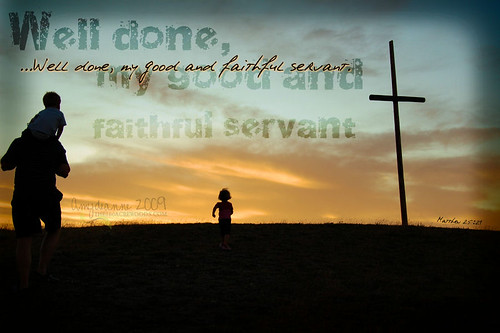
Jesus has some words this Sunday about investing what we receive. He tells the famous parable of the talents. The man who receives five talents, put them to work and made an additional five. The second receives two and makes two more. But the man who receives one talent, buries it. Jesus calls him "wicked" and "lazy." Our Discussion Questions will guide your Sunday Bible Study with family, friends and church groups.
A Different Kind of Accountability
This Sunday's Gospel story presents us with the last of the three parables that form Jesus' final discourse in Matthew's Gospel. Each of the three parables relates a different kind of accountability required of Christians as they prepare for their glorious encounter with Christ.
 The
central message of today's Gospel parable concerns the spirit of
responsibility with which to receive God's Kingdom: a responsibility to
God and to humanity. When the Master gives the servants the talents to
look after he basically turns them from servants into managers.
Fr. Alex McAllister SDS says they are now expected to make decisions
about how to manage the vast amount of money placed in their care. But
despite this promotion, Father Cusick points out that we all remain servants of God. And we are still responsible to God for the way we use the abilities He has given us.
The
central message of today's Gospel parable concerns the spirit of
responsibility with which to receive God's Kingdom: a responsibility to
God and to humanity. When the Master gives the servants the talents to
look after he basically turns them from servants into managers.
Fr. Alex McAllister SDS says they are now expected to make decisions
about how to manage the vast amount of money placed in their care. But
despite this promotion, Father Cusick points out that we all remain servants of God. And we are still responsible to God for the way we use the abilities He has given us. We are also to realize that like the three servants in Sunday’s Gospel, what each of us has been given is different. Some of us have received short straws. So, Fr. John J. Ludvik explains, Jesus does not expect us to “measure up” to our neighbor, per se. But we are nevertheless expected to give life a first class run with these gifts. We are not to bury our talents. How we use our abilities to enrich and help others is our fulfillment of Christ's command to love others as we love ourselves. And Love, explains Fr. John Foley, S. J., is the only one thing he knows spiritually that goes away if it is buried, but which gets greater if used.
Fear Factor
We live with fears. Fr. Orlando, Sapuay, M.S. says some of these fears are so complex or long-standing that we don't even know how we got them or where they originate. But in this passage, the one-talent man not only confesses he was afraid, but he gives us a hint of why that is true. The Good News of Jesus Christ, Fr. Thomas Rosica, CSB explains, is that we must abandon fear and be industrious, reliable and creative in doing God's will, lest we turn out to be like the third slave, "worthless, lazy louts"!
 Our failure to take heed of the rest of what Jesus has said has sometimes made for a spirituality that is a half-truth.
Fr. Ron Rolheiser warns us that in the name of religion, we have
sometimes become unhealthily fearful, timid, and guilt-ridden. This
means that the mere avoidance of serious sin does not make for good Christians.
And if we are not moving forward, as Fr. James Gilhooley wisely
cautions us, chances are good we march full speed backwards. So, perhaps
we should extend the meaning of the parable a little further and think
of the many ways that the life entrusted to us can be wasted, even without doing evil things. Fr. Campion P. Gavaler explains this in his reflection.
Our failure to take heed of the rest of what Jesus has said has sometimes made for a spirituality that is a half-truth.
Fr. Ron Rolheiser warns us that in the name of religion, we have
sometimes become unhealthily fearful, timid, and guilt-ridden. This
means that the mere avoidance of serious sin does not make for good Christians.
And if we are not moving forward, as Fr. James Gilhooley wisely
cautions us, chances are good we march full speed backwards. So, perhaps
we should extend the meaning of the parable a little further and think
of the many ways that the life entrusted to us can be wasted, even without doing evil things. Fr. Campion P. Gavaler explains this in his reflection. Be Ready for the End
Should we be afraid of death? Should we be afraid of the end of time? Fr. Joseph Pellegrino quotes St. Paul who tells the Thessalonians - we know that we should but we shouldn’t be afraid that it will catch us off guard. And what is the antidote to fear? It is this: an attitude of gratitude. Whatever God has given you, Fr. Phil Bloom urges us all, thank Him and ask his help to invest it as best you can.
Feast of the Dedication of St. John Lateran Church
 Last
Sunday, we celebrated the Feast of the Dedication of the Major
Basilica St. John Lateran. It is one of those few feast days on the
Church’s calendar that require some digging
before its value is even minimally appreciated. When we do invest the
time, the yield is rich. So Sr. Margaret J. Obrovac, FSP took out her
shovels and uncovered some gems. Paul Dion, STL also takes this
opportunity to communicate an important element of our Catholic Faith tradition that we do not often consider. It has to do with the churches that have played an important role in our history as Christians.
Last
Sunday, we celebrated the Feast of the Dedication of the Major
Basilica St. John Lateran. It is one of those few feast days on the
Church’s calendar that require some digging
before its value is even minimally appreciated. When we do invest the
time, the yield is rich. So Sr. Margaret J. Obrovac, FSP took out her
shovels and uncovered some gems. Paul Dion, STL also takes this
opportunity to communicate an important element of our Catholic Faith tradition that we do not often consider. It has to do with the churches that have played an important role in our history as Christians.Purposeful Prayer, the Bible & Catholic Wellness
 It
may surprise you to learn that America is decidedly pro-Bible.
According to research commissioned by American Bible Society, Barna
Research polled 2,000 Americans and discovered that nine out of 10 households own a Bible.
A full 86 percent of people surveyed indicated that they consider the
Bible to be sacred or holy. That’s the good news. The bad news is why
aren't they reading it?
It
may surprise you to learn that America is decidedly pro-Bible.
According to research commissioned by American Bible Society, Barna
Research polled 2,000 Americans and discovered that nine out of 10 households own a Bible.
A full 86 percent of people surveyed indicated that they consider the
Bible to be sacred or holy. That’s the good news. The bad news is why
aren't they reading it?This reflection by Msgr. Charles Pope may help us understand the role the Bible plays in our lives. He says only with God’s help can we begin to realize that “The Most important things in life aren’t things” is more than a slogan. Only with God’s help and a lifetime of grace can we ever hope to really appreciate this insight and absolutely true. In heh second of his two-fer reflection on the Bible, he looks at the story of St. Paul’s arrest, beating and imprisonment at Philippi that serves as a kind of paradigm for the radicality of true Christianity and why it so perturbs many in this world.
Cheryl Dickow also delivers her own two-fer this week. In the first one, she talks about Catholic Health and Wellness. She expresses how she has come to realize that while the initial good intention is a necessary first step to health and wellness, a viable course of action must accompany it—preferably something not too painful, boring, or time-consuming. And in her second reflection, she warns about how we often try to insert our own liberties and try to direct God in our prayers every time we suffix the words "so that..." to them. Think about that for a second.
From the Vatican, two stories likewise come down from the pope. First, Benedict XVI is recommending that young people use the Gospel as they make future plans. And secondly, he reminds the world that death and life in Christ is more than a changing season. He says God's intervention in the drama of human history does not obey any natural cycle. It only obeys His grace and faithfulness.
Top Ten Lists
 Here's a couple of Top Ten lists we encountered this week. The first is "10 Steps To Get Involved in the Pro-Life Movement"
by Susan B. Anthony. You might have said to yourself: I am opposed to
abortion, I want Roe v. Wade to be overturned, I want pro-life heroes
to be leading our country and the states, but HOW? This article's for
you.
Here's a couple of Top Ten lists we encountered this week. The first is "10 Steps To Get Involved in the Pro-Life Movement"
by Susan B. Anthony. You might have said to yourself: I am opposed to
abortion, I want Roe v. Wade to be overturned, I want pro-life heroes
to be leading our country and the states, but HOW? This article's for
you. The second list presented by Donna Hicks is a bit more philosphical. It talks about powerful internal self-preservation forces we have that can be so harmful if we don’t develop an awareness of them, and learn how to restrain them. She calls her list the “Ten Temptations”-- ways to maintain your dignity when your instincts think they know better.
Church-Goers and Not
 A Gallup report that fewer Democrats than Republicans tend to be churchgoers.
About 52 percent of Democrats or those who lean Democrat seldom or
never attend church. Among Republicans or those who lean Republican, 38
percent say they seldom or never attend church. Do what you wish with
these numbers, but one soul turned away from God - regardless of
political party affiliation - is one too much. So we Catholics have our
work cut out for us.
A Gallup report that fewer Democrats than Republicans tend to be churchgoers.
About 52 percent of Democrats or those who lean Democrat seldom or
never attend church. Among Republicans or those who lean Republican, 38
percent say they seldom or never attend church. Do what you wish with
these numbers, but one soul turned away from God - regardless of
political party affiliation - is one too much. So we Catholics have our
work cut out for us.Which brings us to the church-goers, some of them you've talked to when they knocked on your doors many times in the past. I am talking about the Protestant missionaries the likes of which I have had the frequent pleasure of entertaining on my front porch for Bible sharing. And I must admit equally for frequent Bible misunderstandings. I can't help but share this funny story from Patrick Madrid. It is a hysterical albeit mythical account of an encounter between a pair of Mormon door-knockers and a Jehovah's Witness homeowner. I mean no disrespect by sharing this tale. But there are some Catechetical lessons Catholics can learn from this.
We Need Your Help Today
For the first time ever, we are sending out an appeal for assistance from our readers. It is no secret that this economy has been hard on Catholic parishes. And it has not been easy for us as well. The Gospel for this Sunday tells us that what Christ has given us is multiplied in its giving.So we ask you to please consider giving a financial gift to our ministry. We will use your gifts - all 100% of it - to construct parish websites and mobile apps for the many needy parishes that currently wait for us to gift them with our service ministry.
Proverbs 19:17 tells us: "He who is gracious to a poor man lends to the LORD, and He will repay him for his good deed.” Your assistance to us will indeed be a good deed in the eyes of God. For you are not just helping our ministry. You are also helping many communities of faith stay strong to their Catholic roots, beginning with the grateful parish members of St. Aloysius Catholic Church in Buckley, WA. Please click here to send your contribution.
Another eventful week in our Catholic World. A blessed and happy new week to all.
Keep the Faith. Peace.
Wally Arida
Publisher & Editor in chief
BURNING QUESTION: Is it OK for God to get angry?
FEATURED BLOG: "So that..."
Post a comment.
Follow us on Twitter
Click Here to receive a FREE SUBSCRIPTION to this weekly email
--


 In
the Sunday Gospel according to St. Matthew we encounter Christ in
conversation with a lawyer who has asked him a question, not in order to
learn, but in a malicious plot to destroy Christ. Out of this evil
intent Christ brings forth the beautiful gift of the "greatest
commandment": "You shall love the Lord your God with all your heart,
and with all your soul, and with all your mind. This is the greatest and
first commandment. And a second is like it: You shall love your
neighbor as yourself. On these two commandments hang all the law and the
prophets."
In
the Sunday Gospel according to St. Matthew we encounter Christ in
conversation with a lawyer who has asked him a question, not in order to
learn, but in a malicious plot to destroy Christ. Out of this evil
intent Christ brings forth the beautiful gift of the "greatest
commandment": "You shall love the Lord your God with all your heart,
and with all your soul, and with all your mind. This is the greatest and
first commandment. And a second is like it: You shall love your
neighbor as yourself. On these two commandments hang all the law and the
prophets." Fr. Alex McAllister SDS shows us how the two commandments quoted
  Inevitably
we end up talking about creeds, dogmas, commandments, and boundaries.
As in any tiny seed, there is present a fairly complete script for this
love's health and growth. Fr. Ron Rolheiser says
Inevitably
we end up talking about creeds, dogmas, commandments, and boundaries.
As in any tiny seed, there is present a fairly complete script for this
love's health and growth. Fr. Ron Rolheiser says  A
couple of weeks ago at a Mass celebration, a baby somewhere toward the
back half of the church began screaming. It started at the Eucharistic
prayer and lasted through the Sign of Peace. After several minutes of
this, the priest stopped Mass and asked the parent to take the
uncontrollable baby outside. As you might imagine, calls poured into the
parish office either complaining about the priest or excusing the
parents. Her bottom line? Sometimes things worth our time and effort come with rules and expectations. Mass should be one of them.
A
couple of weeks ago at a Mass celebration, a baby somewhere toward the
back half of the church began screaming. It started at the Eucharistic
prayer and lasted through the Sign of Peace. After several minutes of
this, the priest stopped Mass and asked the parent to take the
uncontrollable baby outside. As you might imagine, calls poured into the
parish office either complaining about the priest or excusing the
parents. Her bottom line? Sometimes things worth our time and effort come with rules and expectations. Mass should be one of them.  How does one become an effective Catholic? Let's start with prayer. Sister Laus Gloriae, O.C.D. offers her "
 Bob
Hope — “the most honored entertainer” ever, according to the Guinness
Book of World Records, for his achievements in theater, radio, film, TV,
philanthropy and business, and an extraordinary record of service to
country, with 199 USO shows around the globe — won the biggest prize of
all in the waning days of his life
Bob
Hope — “the most honored entertainer” ever, according to the Guinness
Book of World Records, for his achievements in theater, radio, film, TV,
philanthropy and business, and an extraordinary record of service to
country, with 199 USO shows around the globe — won the biggest prize of
all in the waning days of his life  Are
service to God and to Caesar compatible? The Lord commands not only to
give to God what is God's (that is, everything), but also to give to
Caesar what is Caesar's. Jesus’ response tells us that one’s citizenship
does not have to be at odds with one’s faith. It is St. Paul who
reminds us that the moment a person comes into contact with the currency
of the country of which he is a citizen, he thereby acknowledges that
he is obligated to pay for the support of that government, to obey its
laws, to render that government obedience, fear and honor, in fact he is
obligated to pray for that government (1 Timothy 2:2).
Are
service to God and to Caesar compatible? The Lord commands not only to
give to God what is God's (that is, everything), but also to give to
Caesar what is Caesar's. Jesus’ response tells us that one’s citizenship
does not have to be at odds with one’s faith. It is St. Paul who
reminds us that the moment a person comes into contact with the currency
of the country of which he is a citizen, he thereby acknowledges that
he is obligated to pay for the support of that government, to obey its
laws, to render that government obedience, fear and honor, in fact he is
obligated to pray for that government (1 Timothy 2:2).  Protests
and debates about the state of our economy banner our news headlines.
Father Longenecker clarifies that he is a priest and not an economist.
But it doesn't stop him from voicing this thoughts. He opines that the
economic disaster we are now facing is the fault of individuals--not
governments. Put very simply,
Protests
and debates about the state of our economy banner our news headlines.
Father Longenecker clarifies that he is a priest and not an economist.
But it doesn't stop him from voicing this thoughts. He opines that the
economic disaster we are now facing is the fault of individuals--not
governments. Put very simply,  Finally, what’s in a nickname? The many football fans among you will love this. Here are the
