
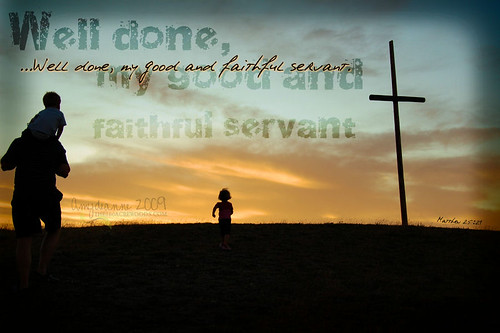
Jesus has some words this Sunday about investing what we receive. He tells the famous parable of the talents. The man who receives five talents, put them to work and made an additional five. The second receives two and makes two more. But the man who receives one talent, buries it. Jesus calls him "wicked" and "lazy." Our Discussion Questions will guide your Sunday Bible Study with family, friends and church groups.
A Different Kind of Accountability
This Sunday's Gospel story presents us with the last of the three parables that form Jesus' final discourse in Matthew's Gospel. Each of the three parables relates a different kind of accountability required of Christians as they prepare for their glorious encounter with Christ.
 The
central message of today's Gospel parable concerns the spirit of
responsibility with which to receive God's Kingdom: a responsibility to
God and to humanity. When the Master gives the servants the talents to
look after he basically turns them from servants into managers.
Fr. Alex McAllister SDS says they are now expected to make decisions
about how to manage the vast amount of money placed in their care. But
despite this promotion, Father Cusick points out that we all remain servants of God. And we are still responsible to God for the way we use the abilities He has given us.
The
central message of today's Gospel parable concerns the spirit of
responsibility with which to receive God's Kingdom: a responsibility to
God and to humanity. When the Master gives the servants the talents to
look after he basically turns them from servants into managers.
Fr. Alex McAllister SDS says they are now expected to make decisions
about how to manage the vast amount of money placed in their care. But
despite this promotion, Father Cusick points out that we all remain servants of God. And we are still responsible to God for the way we use the abilities He has given us. We are also to realize that like the three servants in Sunday’s Gospel, what each of us has been given is different. Some of us have received short straws. So, Fr. John J. Ludvik explains, Jesus does not expect us to “measure up” to our neighbor, per se. But we are nevertheless expected to give life a first class run with these gifts. We are not to bury our talents. How we use our abilities to enrich and help others is our fulfillment of Christ's command to love others as we love ourselves. And Love, explains Fr. John Foley, S. J., is the only one thing he knows spiritually that goes away if it is buried, but which gets greater if used.
Fear Factor
We live with fears. Fr. Orlando, Sapuay, M.S. says some of these fears are so complex or long-standing that we don't even know how we got them or where they originate. But in this passage, the one-talent man not only confesses he was afraid, but he gives us a hint of why that is true. The Good News of Jesus Christ, Fr. Thomas Rosica, CSB explains, is that we must abandon fear and be industrious, reliable and creative in doing God's will, lest we turn out to be like the third slave, "worthless, lazy louts"!
 Our failure to take heed of the rest of what Jesus has said has sometimes made for a spirituality that is a half-truth.
Fr. Ron Rolheiser warns us that in the name of religion, we have
sometimes become unhealthily fearful, timid, and guilt-ridden. This
means that the mere avoidance of serious sin does not make for good Christians.
And if we are not moving forward, as Fr. James Gilhooley wisely
cautions us, chances are good we march full speed backwards. So, perhaps
we should extend the meaning of the parable a little further and think
of the many ways that the life entrusted to us can be wasted, even without doing evil things. Fr. Campion P. Gavaler explains this in his reflection.
Our failure to take heed of the rest of what Jesus has said has sometimes made for a spirituality that is a half-truth.
Fr. Ron Rolheiser warns us that in the name of religion, we have
sometimes become unhealthily fearful, timid, and guilt-ridden. This
means that the mere avoidance of serious sin does not make for good Christians.
And if we are not moving forward, as Fr. James Gilhooley wisely
cautions us, chances are good we march full speed backwards. So, perhaps
we should extend the meaning of the parable a little further and think
of the many ways that the life entrusted to us can be wasted, even without doing evil things. Fr. Campion P. Gavaler explains this in his reflection. Be Ready for the End
Should we be afraid of death? Should we be afraid of the end of time? Fr. Joseph Pellegrino quotes St. Paul who tells the Thessalonians - we know that we should but we shouldn’t be afraid that it will catch us off guard. And what is the antidote to fear? It is this: an attitude of gratitude. Whatever God has given you, Fr. Phil Bloom urges us all, thank Him and ask his help to invest it as best you can.
Feast of the Dedication of St. John Lateran Church
 Last
Sunday, we celebrated the Feast of the Dedication of the Major
Basilica St. John Lateran. It is one of those few feast days on the
Church’s calendar that require some digging
before its value is even minimally appreciated. When we do invest the
time, the yield is rich. So Sr. Margaret J. Obrovac, FSP took out her
shovels and uncovered some gems. Paul Dion, STL also takes this
opportunity to communicate an important element of our Catholic Faith tradition that we do not often consider. It has to do with the churches that have played an important role in our history as Christians.
Last
Sunday, we celebrated the Feast of the Dedication of the Major
Basilica St. John Lateran. It is one of those few feast days on the
Church’s calendar that require some digging
before its value is even minimally appreciated. When we do invest the
time, the yield is rich. So Sr. Margaret J. Obrovac, FSP took out her
shovels and uncovered some gems. Paul Dion, STL also takes this
opportunity to communicate an important element of our Catholic Faith tradition that we do not often consider. It has to do with the churches that have played an important role in our history as Christians.Purposeful Prayer, the Bible & Catholic Wellness
 It
may surprise you to learn that America is decidedly pro-Bible.
According to research commissioned by American Bible Society, Barna
Research polled 2,000 Americans and discovered that nine out of 10 households own a Bible.
A full 86 percent of people surveyed indicated that they consider the
Bible to be sacred or holy. That’s the good news. The bad news is why
aren't they reading it?
It
may surprise you to learn that America is decidedly pro-Bible.
According to research commissioned by American Bible Society, Barna
Research polled 2,000 Americans and discovered that nine out of 10 households own a Bible.
A full 86 percent of people surveyed indicated that they consider the
Bible to be sacred or holy. That’s the good news. The bad news is why
aren't they reading it?This reflection by Msgr. Charles Pope may help us understand the role the Bible plays in our lives. He says only with God’s help can we begin to realize that “The Most important things in life aren’t things” is more than a slogan. Only with God’s help and a lifetime of grace can we ever hope to really appreciate this insight and absolutely true. In heh second of his two-fer reflection on the Bible, he looks at the story of St. Paul’s arrest, beating and imprisonment at Philippi that serves as a kind of paradigm for the radicality of true Christianity and why it so perturbs many in this world.
Cheryl Dickow also delivers her own two-fer this week. In the first one, she talks about Catholic Health and Wellness. She expresses how she has come to realize that while the initial good intention is a necessary first step to health and wellness, a viable course of action must accompany it—preferably something not too painful, boring, or time-consuming. And in her second reflection, she warns about how we often try to insert our own liberties and try to direct God in our prayers every time we suffix the words "so that..." to them. Think about that for a second.
From the Vatican, two stories likewise come down from the pope. First, Benedict XVI is recommending that young people use the Gospel as they make future plans. And secondly, he reminds the world that death and life in Christ is more than a changing season. He says God's intervention in the drama of human history does not obey any natural cycle. It only obeys His grace and faithfulness.
Top Ten Lists
 Here's a couple of Top Ten lists we encountered this week. The first is "10 Steps To Get Involved in the Pro-Life Movement"
by Susan B. Anthony. You might have said to yourself: I am opposed to
abortion, I want Roe v. Wade to be overturned, I want pro-life heroes
to be leading our country and the states, but HOW? This article's for
you.
Here's a couple of Top Ten lists we encountered this week. The first is "10 Steps To Get Involved in the Pro-Life Movement"
by Susan B. Anthony. You might have said to yourself: I am opposed to
abortion, I want Roe v. Wade to be overturned, I want pro-life heroes
to be leading our country and the states, but HOW? This article's for
you. The second list presented by Donna Hicks is a bit more philosphical. It talks about powerful internal self-preservation forces we have that can be so harmful if we don’t develop an awareness of them, and learn how to restrain them. She calls her list the “Ten Temptations”-- ways to maintain your dignity when your instincts think they know better.
Church-Goers and Not
 A Gallup report that fewer Democrats than Republicans tend to be churchgoers.
About 52 percent of Democrats or those who lean Democrat seldom or
never attend church. Among Republicans or those who lean Republican, 38
percent say they seldom or never attend church. Do what you wish with
these numbers, but one soul turned away from God - regardless of
political party affiliation - is one too much. So we Catholics have our
work cut out for us.
A Gallup report that fewer Democrats than Republicans tend to be churchgoers.
About 52 percent of Democrats or those who lean Democrat seldom or
never attend church. Among Republicans or those who lean Republican, 38
percent say they seldom or never attend church. Do what you wish with
these numbers, but one soul turned away from God - regardless of
political party affiliation - is one too much. So we Catholics have our
work cut out for us.Which brings us to the church-goers, some of them you've talked to when they knocked on your doors many times in the past. I am talking about the Protestant missionaries the likes of which I have had the frequent pleasure of entertaining on my front porch for Bible sharing. And I must admit equally for frequent Bible misunderstandings. I can't help but share this funny story from Patrick Madrid. It is a hysterical albeit mythical account of an encounter between a pair of Mormon door-knockers and a Jehovah's Witness homeowner. I mean no disrespect by sharing this tale. But there are some Catechetical lessons Catholics can learn from this.
We Need Your Help Today
For the first time ever, we are sending out an appeal for assistance from our readers. It is no secret that this economy has been hard on Catholic parishes. And it has not been easy for us as well. The Gospel for this Sunday tells us that what Christ has given us is multiplied in its giving.So we ask you to please consider giving a financial gift to our ministry. We will use your gifts - all 100% of it - to construct parish websites and mobile apps for the many needy parishes that currently wait for us to gift them with our service ministry.
Proverbs 19:17 tells us: "He who is gracious to a poor man lends to the LORD, and He will repay him for his good deed.” Your assistance to us will indeed be a good deed in the eyes of God. For you are not just helping our ministry. You are also helping many communities of faith stay strong to their Catholic roots, beginning with the grateful parish members of St. Aloysius Catholic Church in Buckley, WA. Please click here to send your contribution.
Another eventful week in our Catholic World. A blessed and happy new week to all.
Keep the Faith. Peace.
Wally Arida
Publisher & Editor in chief
BURNING QUESTION: Is it OK for God to get angry?
FEATURED BLOG: "So that..."
Post a comment.
Follow us on Twitter
Click Here to receive a FREE SUBSCRIPTION to this weekly email
--


 The
parable tells us that we must exercise stewardship over Gods’ gifts to
us in a responsible manner. It also tells us how God relates to us.
And
The
parable tells us that we must exercise stewardship over Gods’ gifts to
us in a responsible manner. It also tells us how God relates to us.
And  Matthew
masterfully transforms this Sunday's allegorical parable into a rich
account of salvation history. The parable of the wicked tenants reminds
us once again that we cannot control God's continuous merciful outreach
to others. Thomas Rosica, CSB says
Matthew
masterfully transforms this Sunday's allegorical parable into a rich
account of salvation history. The parable of the wicked tenants reminds
us once again that we cannot control God's continuous merciful outreach
to others. Thomas Rosica, CSB says  In the beginning of the second reading St. Paul said,
“Be anxious about nothing, but bring everything to God, through prayer
and supplication united to thanksgiving. And then the peace of God
which surpasses all understanding will guard your hears and your minds
in Christ Jesus.”
In the beginning of the second reading St. Paul said,
“Be anxious about nothing, but bring everything to God, through prayer
and supplication united to thanksgiving. And then the peace of God
which surpasses all understanding will guard your hears and your minds
in Christ Jesus.” There
is much, much more in the Gospel. And Jesus hints at this after he has
told the story: "The stone that the builders rejected has become the
cornerstone; by the Lord has this been done, and it is wonderful in our
eyes."
There
is much, much more in the Gospel. And Jesus hints at this after he has
told the story: "The stone that the builders rejected has become the
cornerstone; by the Lord has this been done, and it is wonderful in our
eyes." “Martin
Luther” is not a popular figure in most Catholic circles.
Understandably so. Most Catholics who think about Luther at all, hold
him responsible for the dividing of Christendom and the problem of
ongoing Christian disunity. Yest when it comes to ecumenism, Mark
Brumley reports that
“Martin
Luther” is not a popular figure in most Catholic circles.
Understandably so. Most Catholics who think about Luther at all, hold
him responsible for the dividing of Christendom and the problem of
ongoing Christian disunity. Yest when it comes to ecumenism, Mark
Brumley reports that  For
Tim Drake, and for the many others suffering around the country, it's
been a tough summer financially. His Buick unexpectedly died and had to
be replaced. His pneumonia led to unexpected doctor’s bills. His
riding lawnmower bit the dust. As the primary provider for our family,
he has tried to shield his children from this reality as best I can,
but they’ve still felt the results. Then on his birthday, his young son
gifted him with something he will never ever forget -
For
Tim Drake, and for the many others suffering around the country, it's
been a tough summer financially. His Buick unexpectedly died and had to
be replaced. His pneumonia led to unexpected doctor’s bills. His
riding lawnmower bit the dust. As the primary provider for our family,
he has tried to shield his children from this reality as best I can,
but they’ve still felt the results. Then on his birthday, his young son
gifted him with something he will never ever forget -  Finally,
Eric Porteous gives us his interview with NFL Quarterback and 3-time
Pro Bowler, Philip Rivers of the San Diego Chargers. A fellow Catholic,
Rivers discusses
Finally,
Eric Porteous gives us his interview with NFL Quarterback and 3-time
Pro Bowler, Philip Rivers of the San Diego Chargers. A fellow Catholic,
Rivers discusses 
 The
two sons in the parable this weekend have some promise. Their father
has a vineyard of his own, something for them to inherit. The vineyard
needs some work, and the father tells both to go and do it. One says no,
but then eventually goes. The other says he'll go work, but never
shows up. Number one son, who said no to his father but who went and
did what his father wanted, is a type for sinners. Number two son, who
says yes to the father but does not deliver, is a stand-in for the
religious authorities of the day who were long on words but short on
deeds.
The
two sons in the parable this weekend have some promise. Their father
has a vineyard of his own, something for them to inherit. The vineyard
needs some work, and the father tells both to go and do it. One says no,
but then eventually goes. The other says he'll go work, but never
shows up. Number one son, who said no to his father but who went and
did what his father wanted, is a type for sinners. Number two son, who
says yes to the father but does not deliver, is a stand-in for the
religious authorities of the day who were long on words but short on
deeds.  We are called to work in the Father's vineyard. Fr. Joseph Pellegrino says the vineyard is your house and my house.
  A reader asks a very serious question from a reader:
  Jennifer
Fulwiler was glancing at a list of saints’ feast days that fall during
this week, when she this listed for September 23: St. Thecla, Virgin and Martyr. As she
Jennifer
Fulwiler was glancing at a list of saints’ feast days that fall during
this week, when she this listed for September 23: St. Thecla, Virgin and Martyr. As she 
 “But
that’s not fair!” Most parents have heard this phrase umpteen times.
The notion of fairness also known as justice, is built into us. It makes
us aware that each of us has certain rights that need to be respected.
Sometimes that's just the way life is, which is in part the point of
the parable of the laborers in the vineyard.
“But
that’s not fair!” Most parents have heard this phrase umpteen times.
The notion of fairness also known as justice, is built into us. It makes
us aware that each of us has certain rights that need to be respected.
Sometimes that's just the way life is, which is in part the point of
the parable of the laborers in the vineyard.  Obviously
the wages as distributed in the parable are not a strict remuneration
for hours worked. they are more like a gift from a fond heart. Fr. John
Foley, S. J. says Jesus told this parable
Obviously
the wages as distributed in the parable are not a strict remuneration
for hours worked. they are more like a gift from a fond heart. Fr. John
Foley, S. J. says Jesus told this parable  Father Cusick goes straight to the point -
  Last
Sunday we celebrated the Feast of the Exaltation of the Cross. Sr.
Margaret J. Obrovac, FSP reflected on the feast and tells us that
Last
Sunday we celebrated the Feast of the Exaltation of the Cross. Sr.
Margaret J. Obrovac, FSP reflected on the feast and tells us that  And finally, here's one about actors
